Batenberg plan

On 2.VI.1881, the first cadastral plan of Sofia was approved by the City Council.

The architects of Old Sofia

At the beginning of the 20th century, the architects of Old Sofia transformed the vision of Sofia, turning it into the European capital with exquisite architecture

Hidden from view

Built at the beginning of the 20th century, buildings in Sofia capture with their lavish decoration, usually Baroque and Art Nouveau
Hidden from view!

The Sky Museum Project

How far does our sight extend? 30-40 kilometers if we are lucky. We can’t see

the sea floor from the mountain top, nor the green jungles from the desert.

In a city like Sofia, it is often impossible to even see across several streets, nor to

meet its millions of inhabitants. But we can see the sun, the moon in the starry sky.

The all-seeing sky. Discover the beauty and rich cultural history

heritage of our capital with the “Sky Museum” project. Open doors to the past

times and immerse yourself in the history of the city with a view from the sky.

Sky Museum

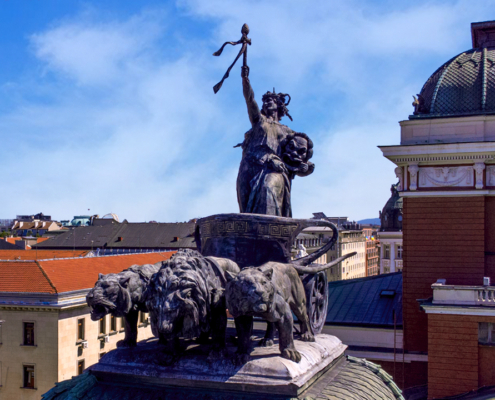
Be a part of the magic. Check out the masterpieces on the roofs of the buildings in the capital!

Discover the magic of Sofia’s buildings

Map with the locations of architectural masterpieces

Enter a specific location and explore the area. Here

1
2
3
4
5
6
7
8
9
10
1

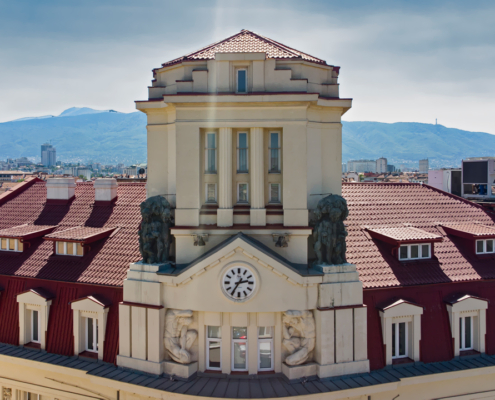
CENTRAL MARKET HALL

2

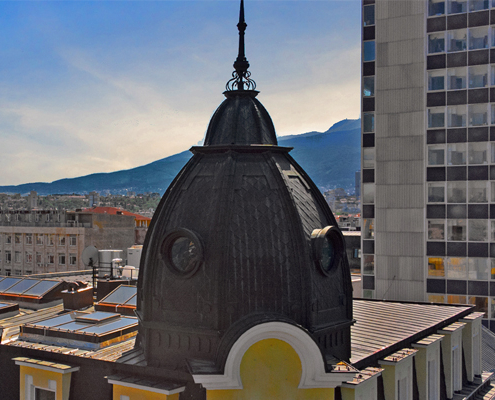
THE BANK BUILDING OF ARCHITECT NIKOLA LAZAROV

3

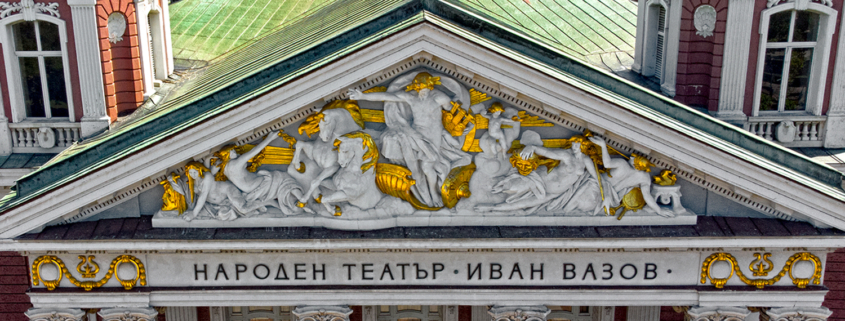
NATIONAL THEATER “IVAN VAZOV”

4

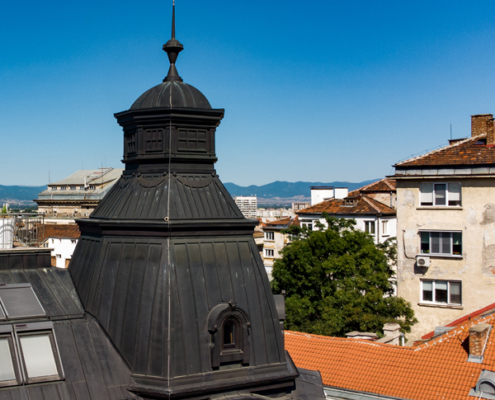
THE BUILDING AT 19 MOSKOVSKA STREET

5

Сградата на бившия Партиен дом

6

NATIONAL ART GALLERY

7

THE BUILDING ON GARIBALDI SQUARE

8

THE BUILDING OF THE FORMER CHAMBER OF COMMERCE AND INDUSTRY

9

THE “CLERK INSURANCE COMPANY” BUILDING

10

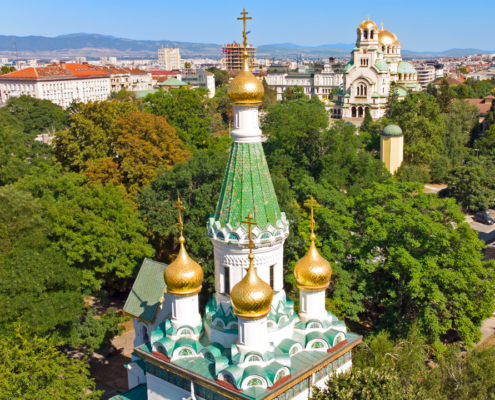
THE RUSSIAN CHURCH

Interesting facts

Get to know interesting facts related to the masterpieces of architecture in Sofia!

The Central Market  Hall was built on the site of an extensive wooden building, in which theater and circus performances were held after the Liberation.

The highlight of the beautiful building is the sculptural group of three human figures holding a globe, symbolizing the cooperative movement.

The National Theater opened its doors on January 3, 1907 with a special performance. Before the grand opening, many students booed Prince Ferdinand I and he decided by decree to close Sofia University for six months.

On the facade of the building, the figure of the god Mercury – god of trade, exchange and communications, masks of Medusa on the ground floor and two eagles at the entrance can be distinguished.

Ornaments in the shape of corn cobs are present on the facades, due to Nikita Khrushchev’s campaign, launched during the construction, for the massive sowing of American corn hybrids.

The Gallery is the former Palace and a converted Turkish inn. According to contemporaries, after the reconstruction, the building acquired the charm of French palaces from the time of the Enlightenment.

Before September 9, 1944, the building was the bank of Atanas Burov. However, the owner of the bank is Georgi Gubidelnikov, and Burov was only its director.

The building was finally completed after the First World War and consecrated on April 6, 1920 in the presence of Tsar Boris III. The value of the plot, the building and the furniture amounted to 325 thousand BGN at the time.

The sculptural image of a healthy Bulgarian woman with two children symbolizes the labor of the people and their concern for the future.

At the corners of the future foundations of the building, four marble stones were established, on which the initials of the Grand Duke Vladimir Alexandrovich, his wife, his son, and Prince Boris, the future king of Bulgaria, were written in golden letters.

Send us your proposal for a building in Sofia!

Contact us!